Avez-vous déjà été perplexe devant votre frigo, vous demandant comment un petit légume cru pourrait se transformer une fois cuit ?
Nous avons tous entendu que manger des légumes est crucial pour une alimentation saine, mais lorsqu’il s’agit de choisir entre les consommer crus ou cuits, les choses se compliquent. La quantité de nutriments change-t-elle ? Et qu’en est-il du volume ? Comment savoir si vous consommez réellement la quantité recommandée de légumes ?
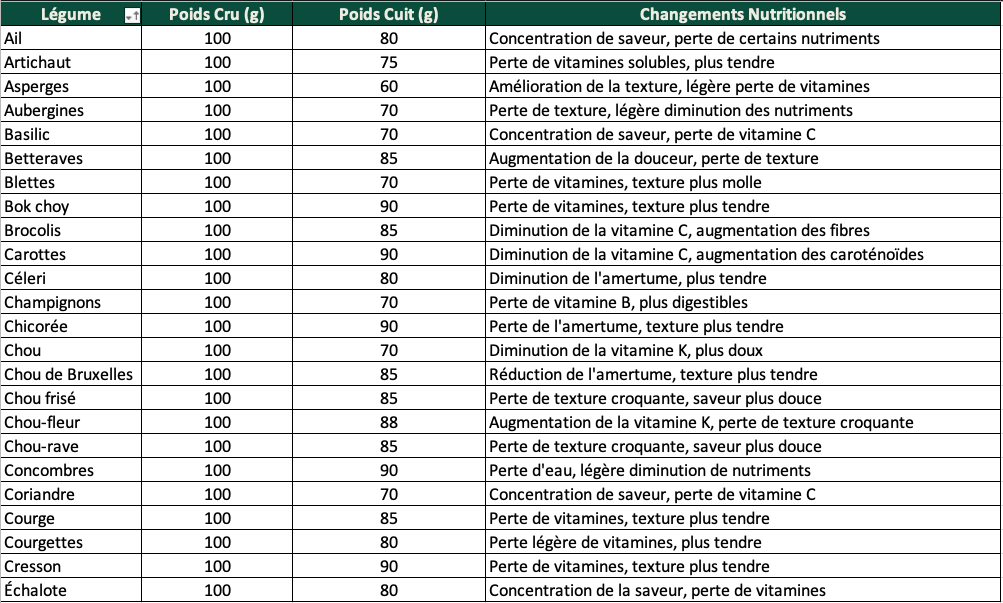
Heureusement, nous avons exactement ce qu’il vous faut : un tableau d’équivalence pratique entre légumes crus et cuits, un outil indispensable pour votre cuisine. Que vous soyez un cuisinier amateur, un passionné de santé, ou simplement à la recherche de clarté dans le monde parfois confus de la nutrition, ce tableau va transformer votre façon de voir et de cuisiner les légumes.
Suivez-nous dans cet article ludique et informatif pour découvrir comment maximiser les bienfaits de vos légumes, que ce soit crus ou cuits, et pourquoi cette connaissance pourrait être un atout majeur pour votre santé.
Le tableau d’équivalence de 50 légumes cuits et crus
Vous vous demandez souvent comment la cuisson transforme vos légumes préférés ? Ne cherchez plus ! Notre tableau d’équivalence est l’outil idéal pour vous guider.
Il compare une grande variété de légumes dans leurs formes crues et cuites, en mettant l’accent sur leurs poids et leurs changements nutritionnels.
Est-ce que la manière de cuire joue sur l’équivalence des légumes crus et cuits ?
Après avoir récupéré le tableau d’équivalence légumes crus et cuits, on peut se demande si la façon dont vous cuisez vos légumes peut avoir un impact significatif sur leur valeur nutritionnelle et leur texture.
Comprendre l’effet des différentes méthodes de cuisson est essentiel pour optimiser les bénéfices santé de votre alimentation.
1. Méthodes de cuisson et nutriments :
- Cuisson à l’eau : Souvent utilisée pour les légumes comme les carottes ou les pommes de terre, cette méthode peut entraîner la perte de vitamines solubles dans l’eau (comme la vitamine C et certaines vitamines B). L’eau bouillante dissout ces nutriments, réduisant ainsi leur quantité dans le légume.
- Cuisson à la vapeur : Plus douce que la cuisson à l’eau, la cuisson à la vapeur aide à préserver les nutriments sensibles à la chaleur et à l’eau. Des légumes comme les brocolis, riche en magnésium, ou les choux de Bruxelles conservent mieux leurs vitamines et minéraux.
- Grillage ou rôtissage : Cette méthode peut augmenter la concentration de certains nutriments, comme les caroténoïdes dans les carottes et les tomates. De plus, elle donne une texture plus croustillante et un goût plus riche en raison de la caramélisation des sucres naturels des légumes.
- Sautage ou cuisson à la poêle : Rapide et efficace, cette méthode conserve la plupart des nutriments tout en ajoutant une riche saveur, surtout si vous utilisez des herbes ou des épices.
2. Changements de texture :
La texture des légumes est grandement influencée par le mode de cuisson. Par exemple, la cuisson à l’eau rend les légumes plus tendres, parfois au point de devenir trop mous. En revanche, la rôtisserie et le gril offrent une texture plus ferme et croustillante. La texture influence non seulement le plaisir gustatif, mais aussi la digestibilité.
3. Impact sur la santé :
Il est important de noter que certains légumes, présent dans le tableau équivalence légumes crus et cuits, lorsqu’ils sont cuits, peuvent offrir des avantages pour la santé non présents dans leur forme crue. Par exemple, la cuisson des tomates augmente la disponibilité des antioxydants comme le lycopène. D’autre part, la surcuisson peut détruire des enzymes bénéfiques et réduire l’apport nutritionnel.
En résumé, la manière de cuire vos légumes a une influence notable sur leur profil nutritionnel et leur texture. En choisissant la méthode de cuisson adaptée à chaque type de légume, vous pouvez maximiser les avantages pour la santé tout en profitant d’une expérience culinaire variée et savoureuse.
Pourquoi comparer légumes crus et cuits présents dans ce tableau d’équivalence ?
Lorsque vous choisissez entre consommer des légumes crus ou cuits, vous ne choisissez pas seulement une méthode de préparation, mais également un profil nutritionnel différent. Cette comparaison n’est pas juste une question de goût ou de texture, mais aussi une question de santé et de nutrition. Alors, pourquoi est-il important de comprendre les différences entre les légumes crus et cuits ?
1. Vitamines :
- Légumes crus : Les légumes crus sont souvent riches en vitamines, notamment les vitamines B et C, qui sont sensibles à la chaleur. En mangeant des légumes crus, vous profitez de la totalité de leur contenu en ces nutriments essentiels.
- Légumes cuits : Certains légumes, lorsqu’ils sont cuits, peuvent offrir une meilleure assimilation de certains nutriments. Par exemple, la cuisson des tomates augmente la disponibilité du lycopène, un puissant antioxydant.
2. Fibres :
- Conservation des fibres : La cuisson modifie la structure des fibres alimentaires dans les légumes. Alors que les légumes crus peuvent offrir plus de fibres brutes, certains types de cuisson, comme la cuisson à la vapeur, peuvent rendre les fibres plus tendres et plus faciles à digérer.
- Impact sur la digestion : Pour certaines personnes, les légumes crus peuvent être plus difficiles à digérer. La cuisson peut rendre les légumes plus doux, ce qui facilite leur digestion et l’absorption des nutriments.
3. Digestibilité :
- Légumes crus : Bien que sains, les légumes crus peuvent parfois causer des ballonnements ou des inconforts digestifs chez certaines personnes, surtout ceux qui sont riches en fibres insolubles.
- Légumes cuits : La cuisson peut rendre les légumes plus faciles à mâcher et à digérer, en particulier pour les personnes ayant un système digestif sensible.
En conclusion, choisir entre des légumes crus ou cuits dépend de vos besoins nutritionnels, de votre santé digestive, et de vos préférences personnelles.
En comprenant les avantages des deux formes, vous pouvez diversifier votre alimentation et profiter pleinement des bienfaits des légumes, quelle que soit la manière dont vous choisissez de les consommer.
Conclusion sur le tableau équivalence légumes crus et cuits
En conclusion, comprendre la différence entre les légumes crus et cuits est un pas essentiel vers une alimentation plus consciente et variée.
Que vous préfériez la fraîcheur des légumes crus ou la douceur de ceux cuits, chaque choix apporte ses propres bienfaits nutritionnels. Notre tableau d’équivalence est là pour vous guider dans cette aventure culinaire.
Alors, n’hésitez pas à expérimenter et à savourer chaque bouchée, tout en enrichissant votre régime alimentaire.