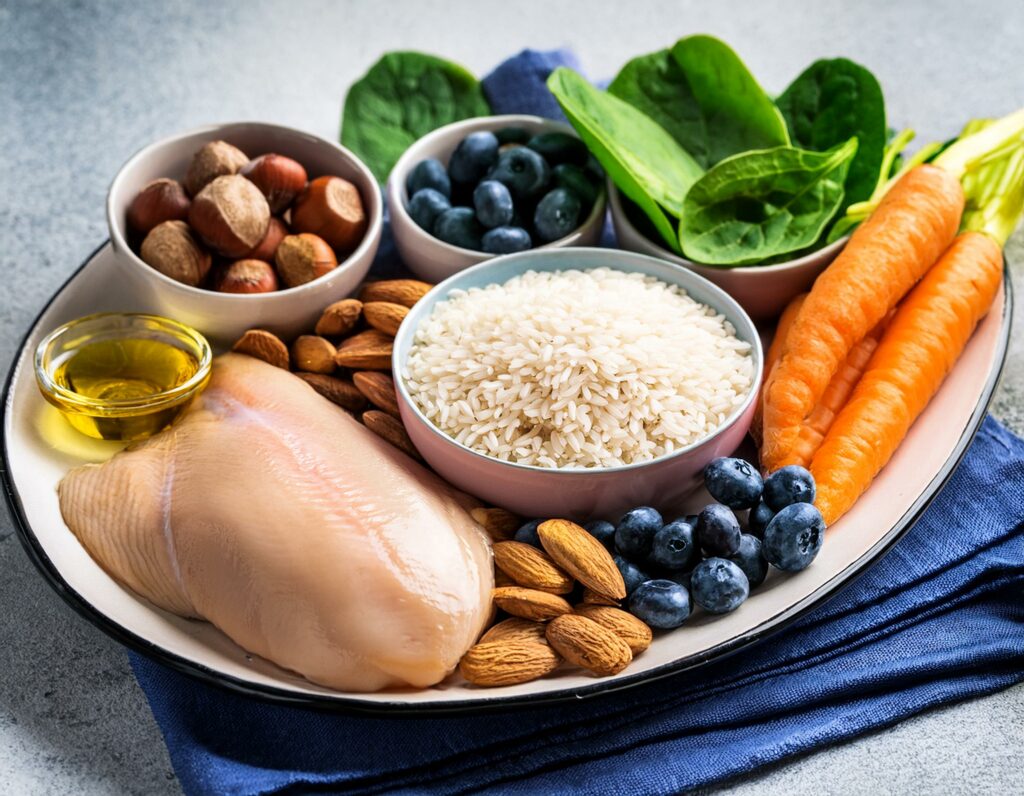
La nutrition joue un rôle capital dans la performance sportive, mais identifier une « nutrition idéale » n’est pas une science exacte. Cela dépend largement des objectifs individuels, du type de sport pratiqué et des besoins spécifiques de chaque athlète.
Toutefois, certains principes généraux peuvent aider les sportifs à optimiser leur alimentation pour améliorer leurs performances et leur récupération.

Quelles sont les bases de la nutrition sportive ?
Un régime alimentaire équilibré pour un sportif doit couvrir plusieurs bases : les macronutriments (protéines, glucides, lipides), les micronutriments (vitamines et minéraux) et l’hydratation.
Les protéines sont essentielles pour la réparation et la croissance musculaire.
Les glucides sont la principale source d’énergie, surtout pour les sports d’endurance.
Les lipides, quant à eux, sont cruciaux pour les exercices de longue durée et jouent un rôle important dans la santé hormonale.
La quantité de calories nécessaires varie en fonction de l’intensité et de la durée de l’activité sportive, mais aussi du métabolisme de base de l’individu.
En moyenne, un homme actif peut nécessiter entre 2,500 à 3,000 calories par jour, tandis qu’une femme active peut avoir besoin de 2,000 à 2,500 calories.
Ces valeurs peuvent augmenter significativement pour les athlètes de haut niveau.
Un exemple de régime alimentaire équilibré
Un menu quotidien pour un sportif pourrait ressembler à ce qui suit :
- Petit déjeuner : Flocons d’avoine avec des fruits frais et une poignée de noix, accompagné d’un smoothie protéiné.
- Déjeuner : Quinoa avec légumes variés, poulet grillé ou tofu pour les végétariens, et une petite portion d’avocat pour les lipides sains.
- Dîner : Poisson ou légumineuse comme les lentilles, accompagné de riz complet et d’une grande salade.
- Collations : Fruits, yaourts riches en protéines, ou des barres énergétiques maison.
Pour en savoir plus sur l’équilibrage de ces éléments dans un cadre sportif, vous pouvez consulter des ressources spécialisées, comme sur Fitnko.
Une alternative végétarienne
Pour les sportifs végétariens, l’accès aux protéines peut sembler plus compliqué, mais de nombreuses options sont disponibles.
Les protéines végétales telles que les lentilles, pois chiches, tofu, tempeh et les grains entiers sont d’excellentes sources.
Il est important pour les végétariens de varier leurs sources de protéines pour obtenir tous les acides aminés essentiels.
Quelle est l’importance de la nutrition dans le sport ?
La nutrition influence non seulement la performance, mais aussi la récupération, la prévention des blessures et la santé générale.
Un apport équilibré en nutriments aide à maintenir le corps en état de fonctionner à son pic d’efficacité, réduit la fatigue et permet une récupération musculaire optimale.
De plus, une bonne hydratation est essentielle, car même une légère déshydratation peut diminuer les performances physiques et mentales.
Il n’y a pas de « régime unique » pour tous les sportifs, mais une approche basée sur les principes de variété, d’équilibre et d’adaptabilité en fonction des besoins individuels et des objectifs spécifiques peut aider chaque athlète à trouver son régime idéal.
La consultation avec un nutritionniste sportif peut également être bénéfique pour personnaliser le plan alimentaire et assurer qu’il couvre tous les aspects nécessaires pour soutenir un entraînement rigoureux et compétitif.
En fin de compte, une nutrition adéquate est aussi cruciale que le plan d’entraînement lui-même.